My research began with a fascination for how light interacts with matter—especially how structural differences at the molecular level can create functionality. As an undergraduate, I worked on bismuth oxyhalide nanoplates as a photocatalyst for dye degradation, which first revealed to me the power of structure in governing material response.
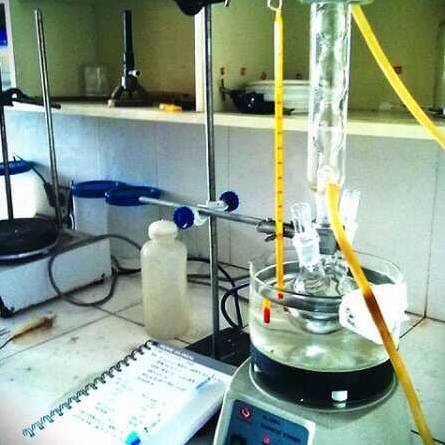
Experiment setting for synthesis of BiOX layered photocatalysts on 3/3/2012
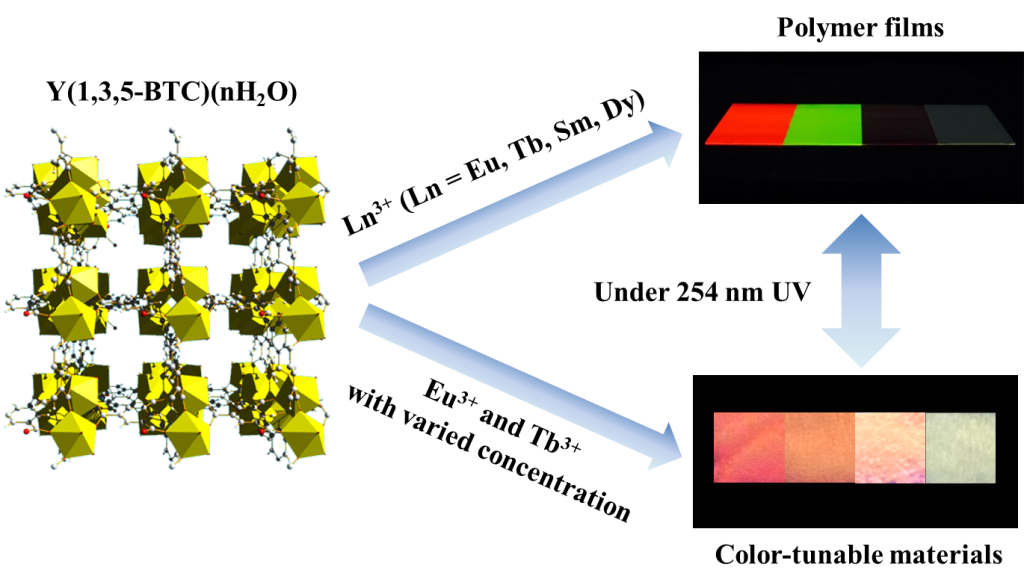
Later, I investigated white-light phosphors by incorporating multiple lanthanide components into hybrid microporous luminescent systems under the supervision of Prof. Bing Yan. This experience sparked a lasting fascination with one of the most compelling concepts in materials science—the relationship between structure and function.
A series of lanthanide-doped yttrium 1,3,5-benzenetricarboxylate (Ln = Eu, Tb, Sm, Dy) materials were synthesized via a solvothermal method. The resulting polymer films extend potential applications in plastic photonic devices.
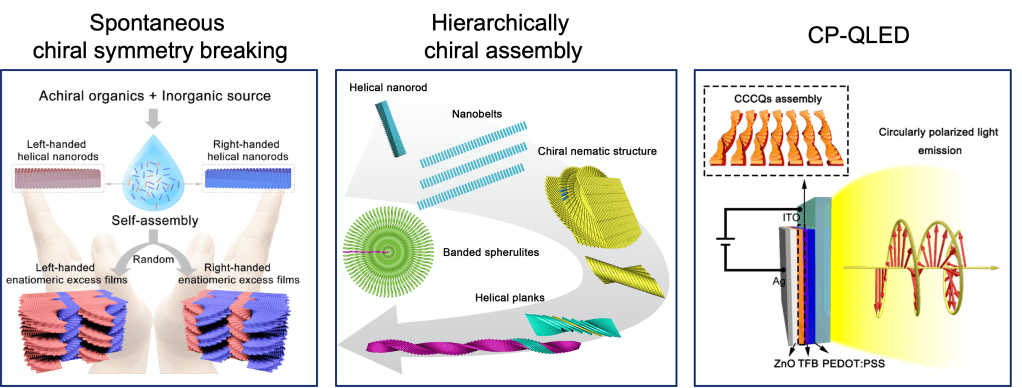
During my PhD, I was introduced to chiral materials, and became intrigued by how structural asymmetry could mimic the dynamic responsiveness found in biological systems. I learned from pioneering mentors like Prof. Shunai Che, Prof. Lu Han, and Prof. Yingying Duan, exploring chiral liquid crystal phases, self-assembled nanostructures, and hierarchical chirality.
I also investigated spontaneous symmetry breaking in CdSe/CdS nanocrystal assemblies, discovering how subtle structural asymmetries could result in unpredictable yet functional behaviors. This concept came to life when I began working on LED fabrication, with the help from Prof. Xiaojun Guo and Dr. Sujie Chen, where material design have the potential to directly influence real-world applications.
Exploring assembly and optical activity of chiral CdSe/CdS nanocrystals
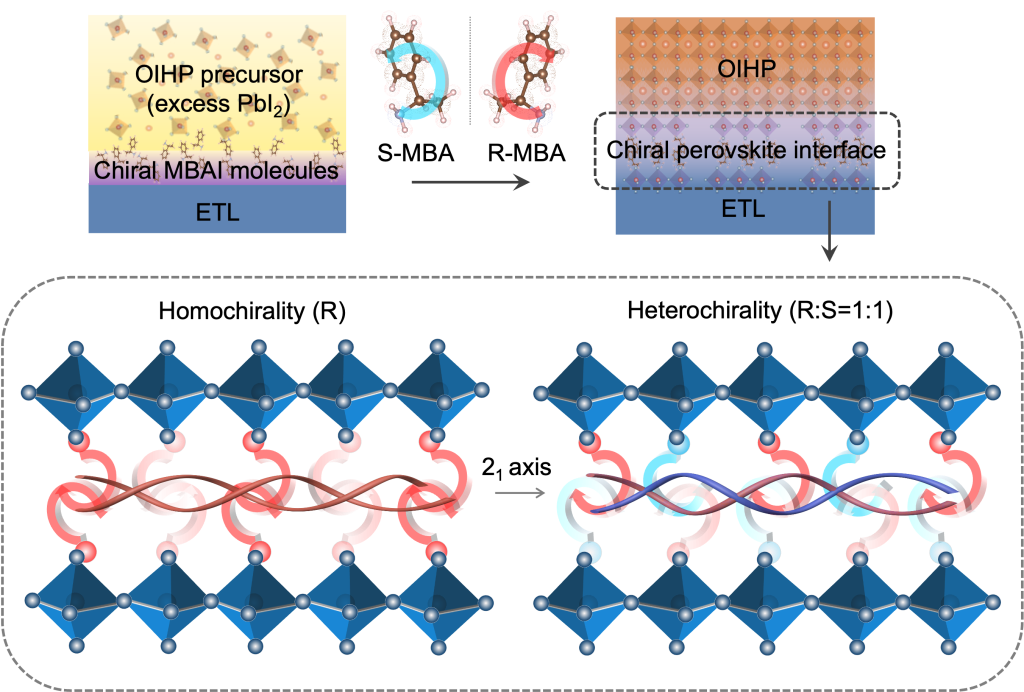
During my postdoc and RAP training with Prof. Yuanyuan Zhou, I developed a chiral interfacial design that enhanced the mechanical durability of perovskite solar cells , and established an in situ light-incorporated TEM method to study structural dynamics under illumination. I became convinced that the future of high-performance energy devices lies in designing materials with built-in responsiveness, compatibility, and purpose for integration, guiding my current research focus on asymmetric interfaces and adaptive optoelectronic systems.
Schematic illustration of chiral interface synthesis by incorporating R- or R/S-methylbenzene ammonium iodide (MBAI) for enhancing the interface mechanical properties of perovskite solar cells
Today and Beyond
These experiences shaped my vision for the M-ART Lab — short for Materials with Asymmetry, Responsiveness, and Tunability.
We are building a research platform where structural asymmetry becomes a tool for functionality, not a flaw. Our lab explores:
Chiral materials for spintronic and optoelectronic devices
Adaptive interfaces with self-healing and stimuli-responsiveness
Quantum and collective effects in asymmetric architectures
The M-ART Lab logo features a stylized chiral spiral interwoven with abstract forms that subtly evoke the letters ‘M’, ‘A’, and ‘T’—symbolizing Materials with Asymmetry and Tunability. Its geometric flow reflects the lab’s vision of responsive, functional design rooted in asymmetrical structure.
We believe that materials inspired by asymmetry and complexity can lead to breakthroughs in energy devices, sensing, and information technologies. At M-ART Lab, science meets design, and we invite curious, self-driven minds to join us on this journey.
At M-ART Lab, we are dedicated to the design and exploration of asymmetric, responsive, and tunable materials for next-generation optoelectronic and energy applications.
Our research weaves together chemical synthesis, symmetry-breaking phenomena, and device integration, while cultivating a mindset that values structure, function, and the beauty of scientific asymmetry.
We foster a culture of mutual support and open communication, where every member learns from each other and receives support from the PI. Our lab is committed to not just advancing scientific knowledge, but also encouraging personal and intellectual growth, and nurturing a sense of integrity and purpose in each individual’s journey.


 DUANLAB for M-ART
Leave a comment